🏨 ** Mahaliana - Environnement et Tourisme **.
🏝️ * À la recherche d'un lieu d'exception pour votre escapade? Plongez dans l'univers des hébergements charmants et des séjours inoubliables au cœur de cette destination enchanteresse.
Climate Change
“Madagascar faces two extremes:between floods and drought”
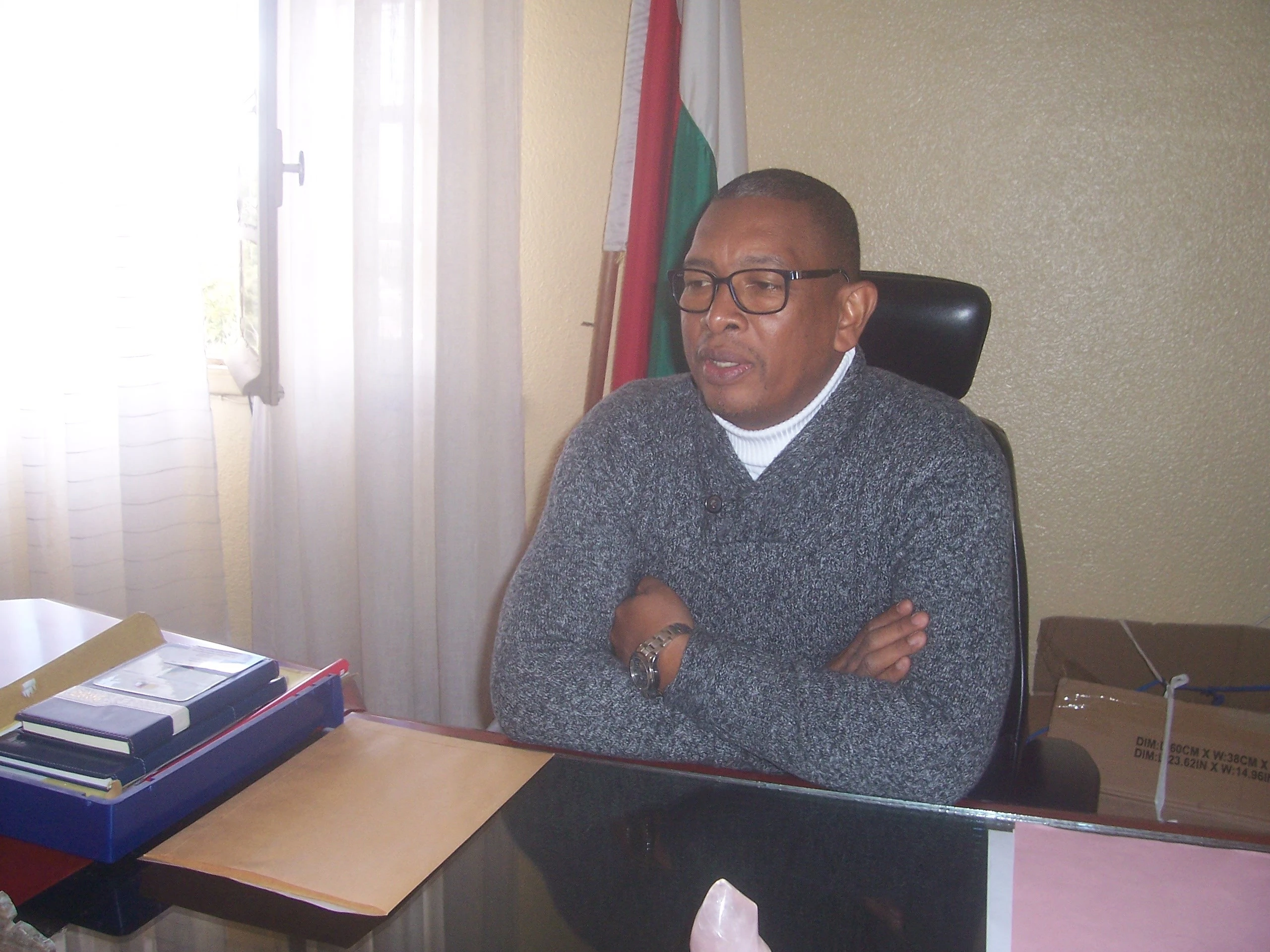
Madagascar is one of the countries most affected by "climate change" on a global scale1. To learn more about its manifestations and his experience, we conducted a survey at the General Directorate of Meteorology (DGM) of Madagascar in Ampandrianomby-Antananarivo. The Director General of the DGM, Mr. Luc Yannick Andréas Randriamarolaza, agreed to be interviewed by our magazine Voandalana Ami du Voyageur (VAV). He holds a doctorate in "climate change and environment" from the Rovira i Virgili University (URV) in Spain, and is the author of numerous scientific publications2 . Here are the highlights of our interview.
VAV (Voandalana Ami du Voyageur): What can be said about climate change in Madagascar?
DG Météo (Directeur Général météorologie nationale): It is best to start with the change in rainfall. The change can be measured. “Climate change is measured using climate variability,” whether it’s daily, monthly, or annual. When it repeats itself, it gives rise to trends or “trends.”(…) Something to expect, that’s what we call “hope.” “We live with the weather, we hope with the climate.” In general, delayed rains cause delayed in agriculture. There is the pouring of rain, called “Induced Rains.” Clouds, there is water, we need to add a boost. Natural rain is created there. Salt is used to pour it. It is often done for energy (Jirama), to help (produce) electricity. It is done around October/September. In the past, the arrival of rain was in October, for Antananarivo. Now there is a delay of 2 or 3 months.
Rainfall and drought
VAV: What about the drought in the South?
DGM: Regarding the South, which is below the Capricorn line, it is more susceptible to “drought”. According to the research I did, if this change could have “possibilities” for water to occur during the passage of “climatic disasters” or “phenomena climatic". "Climate hazards" allow people to prepare to protect themselves and their property from becoming "catastrophes". Regarding the so-called "Meteorological Drought", it is most severe in areas with a lot of rain, for example in the East.
VAV: For us, how does "climate change" really cause it?
DGM: In general, "climate change" is caused by human activity. It is the water that falls that turns into water for us. Every year, this cycle or cycle continues. However, humans interrupt that cycle. For example, we fill up water storage areas. Then the water we receive becomes less, which leads to many changes in our daily lives.
VAV: What about the arrival of rain and rainfall?
DGM: What we are seeing now is that the arrival of rain is generally delayed compared to the past (…).The rainy season is becoming shorter (in general). That is, it starts later but it can also end earlier (…).What is the result? The result is that the rain is becoming heavier. That is, the rain that should have fallen. This could be something like the last incident we experienced in Antananarivo, for the flood in Antananarivo: eighty percent of the amount of rain that should have fallen in a month fell in five days. What month was that, February 2025? If we look at it in terms of the year, we see a decrease, but the decrease is not very significant. The rainfall is decreasing, but the decrease is not that significant. The time it rains is getting shorter, so we are getting torrential rains(…)What we see and feel now is that it is damaging the infrastructure which(…) If you go to Ambohijatovo, in the highlands, all the rocks are falling(…) The infrastructure is being washed away by the torrent.
One of the measures that should be taken is: everyone should collect rainwater because it is raining. Rainwater should not be allowed to flow, because it is raining, it should be retained, it should be stored so that it does not damage the infrastructure. But it is also an advantage because it allows you to get rainwater (…). This change requires you to adapt your lifestyle to the reality. That is our role. Helping people, informing people where the trend is going. So how can we adapt all work and activities to suit it.
That is, for example, when we talk about the arrival of rain in general. What causes it to arrive late but may stop early, in general, is that heat is increasing again. That is the two extremes: either it is flood, or it is causing heat. The land becomes dry. (…) We are distracted by the fact that it is raining. We do not have a view that it is going to be stored but that it will no longer exist after that and it will dry up again.
Wildfires
VAV: Do the fires have an impact on us in Madagascar?
DGM: Absolutely. Because we think that when we burn, the burnt smoke becomes a cloud. NO. If it is dry, it is hot smoke inside and there will be no moisture at all. “It is wrong to say that the place is burned to get rain”. But even more so, the burning of that fire creates a lot of heat in the “atmosphere”, that heat which then destroys the moisture that should be deposited, which then turns into rain. In other words, the fires are part of what leads to...reinforcing the change we are already experiencing. So we need to take action.
VAV: I would like to add to that, finally, is it true that the claim that bushfires (bush fires/forest fires) are one of the reasons why rain is not falling; for example, in Antananarivo and the surrounding area, there is no rain. Is that true? DG Météo: Of course, because sometimes we notice it, we see clouds, but for example, the rain never comes. Because as I explained earlier, the bushfires heat the “atmosphere” below, so even if the rain falls, it disappears above, because the “atmosphere” below is too hot. So the rain cannot fall at all, because all the clouds above collapse on their own. The idea that the smoke becomes rain, becomes clouds, is very wrong. Because there are no clouds, and everyone knows that clouds bring rain. So we think that let's burn it, and that smoke becomes a cloud. However, that smoke has no moisture, no water at all in it, but it brings complete dryness again, and then there is no rain.
Future forecast
VAV: Finally, I would like to conclude by saying that this is a general forecast, just an estimate, as a specialist in Madagascar. What could happen if this were the scenario? What if this is what could happen. Is it a very dark, very bad picture if this continues, or what if? Whether it is in terms of drought, or in terms of rainfall?
DGM: What is already known and confirmed worldwide is that we may be in trouble if, for example, the temperature of the earth around the world rises to +2 degrees C, in the way we live as humans. This means that we always need to be able to adjust our lives to the things that already exist in our lives. I have already mentioned what we are experiencing at the moment. What we should do is not to extend it, that is, we follow the measures like…ours, that is, we will bring more of the change that is the burning, the burning of vegetation. Because these vegetation generally store water. And these vegetation also improve the air we live in so that various diseases do not occur. As soon as the rain does not come, nothing purifies the “atmosphere” and causes diseases. This means, first of all:
The first and last thing we can do is to not increase the heat by destructing the environment (…).What causes the high temperature when there are no more plants in a place is, of course, that the place is very hot because of the lack of plants.
The second thing, it is good to understand that what we are experiencing is not really a "negative" picture, but there are things we can do to adapt it to our lives because there are also benefits, there are "opportunities". The existence of "cyclones" is not forgotten, but if there is no "cyclone", we will not get rain to live. This is something that should really be protected. However, we need to be able to prepare. We need to be able to take precautions when these times come by listening to various news, especially those issued by the National Center for Meteorology, which tells us in advance of their arrival, so that we can enjoy the benefits within it. Because there is a benefit that it brings, namely obtaining a lot of water, but we need to be able to protect it.
But if the damage continues and the cyclones become more and more powerful, then we may be in trouble. But that is the diagram (it is difficult to answer your question about what the diagram is). But the picture so far is not necessarily "negative" but our ability to adapt our lives to what is now and to maintain and calculate what we already have, so as not to change the world to strengthen the change
VAV: How is the temperature in Madagascar, warming up… Is it winter now, is it getting warmer in winter? How is the temperature in Madagascar in general?
DGM: In general, for Madagascar, the temperature is rising first. We may feel cold at the moment. But don't forget that it is measured by what is hot and cold. But in general, if we look at the temperature trend, we are warming up. The temperature is rising. But there is also the feeling that we are getting colder because our bodies are already weakening.
VAV: DG's conclusion after all that, we are always talking about "climate change"
DGM: The good thing to know, to inform us of what is being done, so that this "climate change" is scientifically informed, is so that we can first prepare and know what may happen and what already exists and what may happen in the future. The important thing is that we all try to protect what already exists so that this change does not add to the burden. That is, to establish strategies to be able to adapt or do "adaptation". Because this change, no matter what efforts we make, must always have the impact of the damage that has already occurred. That means, we may always experience the change, we need to adapt our work or "activities" we do, so that we simultaneously protect the environment from being damaged so as not to add to the burden. That is probably what I want to encourage people to do. In order to be able to do this adaptation, one of the important things is to follow the weather conditions. As I explained at the beginning, we really experience it on a daily basis. That is, on a daily basis, the Meteo gives us the possible daily changes through the scales, through the daily measuring instruments. The measuring instruments are used in many different places. This is also what will motivate us: these measuring instruments are always good to protect them because they are common property. If these measuring instruments are not there or if we damage them, we will never know where we are heading in this change. This is also what will motivate everyone who can help and give impetus to these measuring instruments. Because “Only what is measured can be managed. If we do not measure this change, we will not know how to manage it.”
Interview by Ami Ral
11 Juillet 2025